If a lime softening plant using a recarbonation process, where does this process occur? Before or after lime softening? Why is recarbonation used? How is recarbonation accomplished?
Show the overall softening chemical equation for calcium bicarbonate removal using lime
Show the chemical equation for carbon dioxide dissolving into water
In lime softening, which of the following is the most costly hardness to remove? Why?
A. Ca(HCO3)2
B. MgCO3
C. CaCl2
D. MgSO4
The name and the chemical formula for the most common form of carbonate hardness is
What is the most common cation that forms hardness? What is the second most common cation that forms hardness?
| Matching | |
| 1. Chloride | A. NCl3 |
| 2. Chlorine gas | B. HOCl |
| 3. Hydrochloric acid | C. OCl– |
| 4. Hypochlorite | D. Cl2 |
| 5. Hypochlorus acid | E. NHCl2 |
| 6. Monochloramine | F. HCl |
| 7. Dichloramine | G. NH2Cl |
| 8. Trichloramine | H. Cl– |
What is the most common chloramine formed when chlorine reacts with ammonia in water?
A. Monochloramines
B. Dichloramines
C. Trichloramines
D. Organic chloramines
E. All of the above
Source: USEPA 29 Questions on chloramines, http://www.epa.gov/safewater/disinfection/chloramine/
The purpose of the USEPA Ground Water Rule is to reduce disease incidence associated with disease-causing microorganisms in
A. Drinking water
B. Non-point sources
C. Storm water
D. Wastewater
Source: USEPA Ground Water Rule, http://www.epa.gov/safewater/disinfection/gwr/regulation.html
The USEPA Ground Water Rule becomes effective on
A. December 1, 2009
B. July 1, 2010
C. December 1, 2010
D. July 1, 2011
Source: Iowa Department of Natural Resources’ Water Supply Listserv – November 10, 2009
Which of the following is another name for ion exchange softening?
A. Electrodialysis
B. Lime-soda softening
C. Nanofiltration
D. Zeolite softening
Chlorine ton cylinders at room temperature will deliver gas at a maximum rate of
150 lb cylinders Ton Containers
A. 10 pounds per day 100 pounds per day
B. 25 pounds per day 250 pounds per day
C. 40 pounds per day 450 pounds per day
D. 150 pounds per day 2000 pounds per day
Which of the following valves only permits flow to move in one direction?
A. Butterfly
B. Check
C. Gate
D. Plug
The specific gravity of a colloidal solid is very close to 1. This means that the colloid
A. Will float within an hour
B. Will settle within an hour
C. Won’t settle or float
The specific gravity of a settleable solid is
A. 1
B. Greater than 1
C. Less than 1
The specific gravity of a floatable solid is
A. 1
B. Greater than 1
C. Less than 1
The specific gravity of chlorine gas is
A. 1
B. Greater than 1
C. Less than 1
| Matching | |
| 1. Calcium | A. C |
| 2. Carbon | B. S |
| 3. Chlorine | C. P |
| 4. Copper | D. K |
| 5. Fluorine | E. O |
| 6. Iron | F. Na |
| 7. Hydrogen | G. N |
| 8. Lead | H. Mg |
| 9. Magnesium | I. Ca |
| 10. Manganese | J. Cl |
| 11. Nitrogen | K. Cu |
| 12. Potassium | L. Mn |
| 13. Sodium | M. Fe |
| 14. Oxygen | N. H |
| 15. Phosphorus | O. Pb |
| 16. Sulfur | P. Fl |
Which of the following is correct?
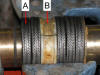
A. A is the follower and B is the lantern ring
B. A is the lantern ring and B is a packing ring
C. A is a packing ring and B is the lantern ring
D. A is a packing ring and B is the follower
pH measures
A. H+
B. OH–
C. O2
D. Phosphorus
How do you know that your pump is cavitating?
A. It doesn’t sound right
B. It runs hot
C. It won’t start
D. All of the above
A chlorine atom is composed of
A. Electrons
B. Neutrons
C. Protons
D. All of the above
Throttling the discharge valve on a centrifugal pump will the likely ______ temperature of the motor and ______ the temperature of the pump
A. Increase, increase
B. Increase, reduce
C. Reduce, increase
D. Reduce, reduce
The chemical symbol for chlorine gas is
A. Cl
B. Cl–
C. Cl2
D. HOCl
Which of the following is the indicator used for pathogens?
A. Amoebic dysentery
B. E. coli
C. Salmonella typhosa
D. V. comma
Pump suction and discharge pressures are usually measured in
A. gpm
B. kWh
C. mg/L
D. psi
Which of the following is the correct formula for chlorine in water?
A. Cl2 + H2O → HOCl + HCl
B. NaOCl + H2O → HOCl + NaOH
C. Ca(OCl)2 + 2H2O → 2HOCl + Ca(OH)2
D. HOCl → H+ + OCl–
E. All of the above
Which of the following describes flocculation?
A. Suspended solids that are too small to settle
B. Quiescent conditions that allow settleable solids to settle
C. Neutralizing charges
D. Growth of smaller solids into larger masses that will settle
Hypoxic zones are caused by high levels of
A. Colloidal suspended solids
B. Dissolved O2
C. Nitrogen & phosphorus
D. Pathogens
The PE for flow is _____ gpcd.
A. 7.48
B. 8.34
C. 150
D. 250